Home
World AIDS Campaign 2008 - Wake Up Pune is taking part in a big way! - Events
World AIDS Campaign 2008 - take part with Wake Up Pune - Volunteer
HIV Bootcamp - free interactive HIV training sessions for young Puneites - Details

ignorance, fear and stigma surrounding HIV."
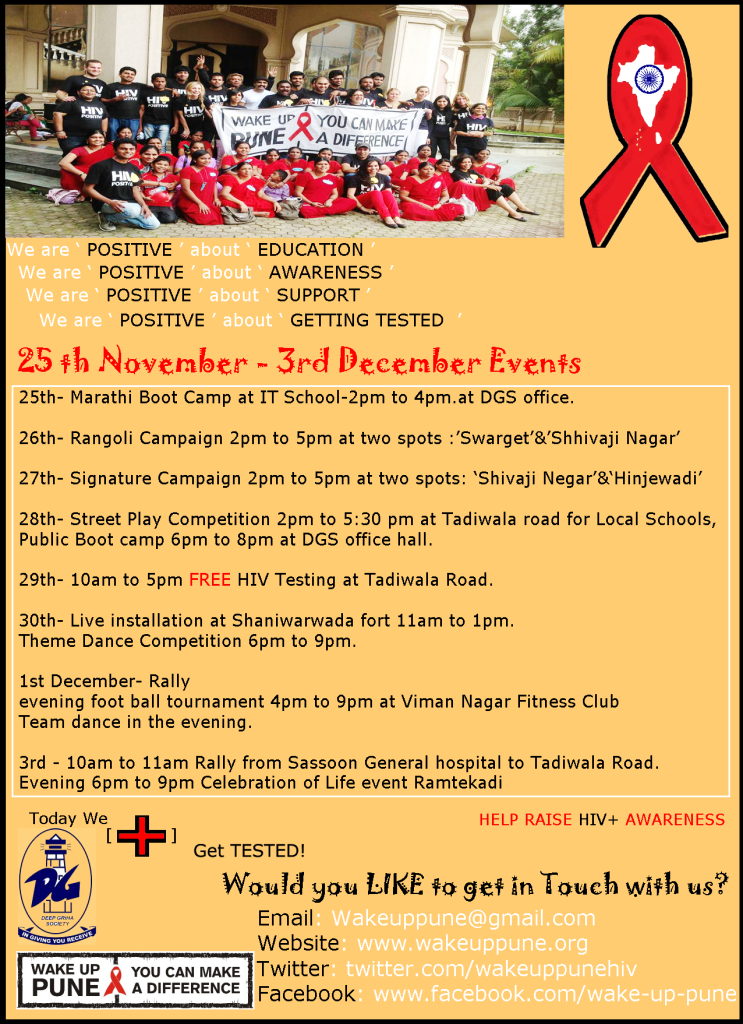
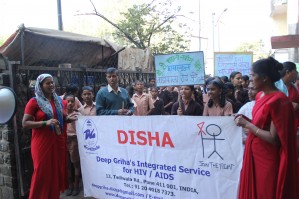
Launched in November 2006, Wake Up Pune is a coalition of NGOs and representatives from civil society working to spread awareness about HIV and AIDS in the city of Pune, India.
Official figures report that in Jan-Oct 2007, 18,039 people in the city were tested for HIV at government testing centres. Of these, 12.27% tested positive. These figures exclude the thousands of people already living with HIV in Pune, along with those who are as yet unaware of their HIV+ status.
Silence, Ignorance, Fear, Stigma and Discrimination fuel the spread of the virus in this community. So many people are dying of a preventable and treatable condition because they are afraid of accessing the correct information and resources that can save their lives! Stigma and discrimination - from peers, colleagues, friends, family - lock people living with HIV (PLHIV) into a state of denial and silence about their condition. Often, this prevents PLHIV from seeking help until it's too late.
Pune needs to wake up and change its attitude. We need to become more positive about HIV, not only to prevent further transmission, but to also better the lives of the many neglected and stigmatized individuals living with and affected by HIV.
HIV does not discriminate. We do. Let's put an end to this vicious cycle.
Join the fight - volunteer with Wake Up Pune.
Issue 10 of InfoChange Agenda is now available online. The theme for this issue is HIV/AIDS: The Big Questions. Agenda is published by the Centre for Communication and Development Studies, based here in Pune.
HIV News Stories
Winnie Sseruma has been living with the disease for over 20 years. Preparing for her trip, UK-based Winnie discovered that the United States was one of 70 countries worldwide that either banned or restricted inbound travel for people with HIV.
"I was told I needed to come to the U.S. embassy for an interview and bring a doctor's letter stating I was fit to travel," Sseruma, HIV coordinator for charity Christian Aid, told CNN.
"At first, the embassy told me that the first available appointment for my interview would be at a date past the U.N. High-level Meeting I was meant to attend."
Only when the U.N. intervened on Sseruma's behalf was she granted an earlier interview date.
Sseruma was relieved when she finally received her visa on time. But the hurdles were far from over. At the airport in New York, Sseruma was detained twice for further questioning.
"It was so humiliating," Sseruma said. "The immigration officers were asking me very personal questions about my health."
A month after Sseruma's ordeal, the U.S. Senate passed the re-authorization of President Bush's Emergency Plan for AIDS Relief (PEPFAR), including an amendment to the ban on travel and immigration for HIV-positive non-citizens.
But the United States travel ban still remains in effect, and will continue to be the law until the Department of Health and Human Services (HHS) modifies its regulations. Fifty-eight Members of Congress have sent a letter to the HHS, urging them to take action.
Anouk Lorie, for CNN.com
The campaign, which included television and radio advertisements, reached 150 million men, especially migrant workers who frequent sex workers.
"There are still huge problems in promoting condom usage. Sex workers tell us that men would rather pay more than use a condom," Sujatha Rao, the chief of National AIDS Control Organization (NACO), told reporters.
India has an estimated 2.5 million people living with HIV, according to the United Nations.
Health officials are targeting sales of three billion condoms annually by 2010 from the current 1.7 billion as well as the use of female condoms by improving the retail network.
"Our biggest barrier is the lack of a proper marketing network," NACO's Rao said.
Inquirer.net
INDIA SHOULD use its legendary IT skills to drive its health sector programmes, including HIV/AIDS information and treatment. "The world learned from India when its pharma companies saved over 3.5 million people from sure death by providing affordable AIDS medicine. India should similarly use its IT skills for its own health sector and ensure everyone everywhere has access to information and healthcare facilities," said Jeffery O'Malley, director, HIV/AIDS group, Bureau of Development Policy, UNDP, in an exclusive to Hindustan Times.
India still has time to reverse its HIV epidemic, with states already showing results. IV prevalence in the general population in Maharashtra dropped from 0.80 per cent to 0.74 per cent in 200506, and in Tamil Nadu, from 0.47 per cent to 0.39 per cent. "Unlike in Africa, HIV infection in India is driven by a small identifiable proportion of the popula- tion-female sex workers, migrants, injecting drug users and MSMs-and working with them is very effective," said O'Malley.
India has 2.5 million people living with HIV, with infection being a high 5.69 per cent among Men who have Sex with Men (MSM) and 5.38 percent Female Sex Workers (FSWs). Most government programmes target female sex workers and their clients through condom promotion and information campaigns.
Issues related to gay rights have been a real disaster in India, as in the rest of the world, said O'Malley.
"Governments the world over find it easier to talk about female sex workers than men who have sex with men. Even when the Gates Foundation started HIV interventions in India, the focused on female sex workers and injecting drug users. To their credit, they now work with men who have sex with men (MSMs), though it's mostly with commercial MSMs. While infection is reversing in sex workers in states like Tamil Nadeu and Andhra, it is increasing among MSMs across the country," he said.
With California voting to ban same-sex marriages through a referendum that circumvents its own Supreme Court ruling in May that legalised same-sex marriages, discriminating laws exist against MSMs are many countries. "The HIV epidemic among MSMS will go underground unless legal and social issues related MSM are not addressed," he said.
AIDS in India
People with HIV and AIDS: 2.5 Million
Men: 61%
Women: 39%
Early on October 20, Bangalore police arrested five hijras – a traditional cultural identity for working-class transgender people who, born as men, identify as women. Such arrests are sadly routine. Throughout India, many hijras cannot get identity papers: the state will not let them change their legal sex and denies them IDs if their appearance does not match their birth gender. As a result, they often cannot work, go to school, find jobs, vote, or even move around freely. Social prejudice against "men" or "women" who are not "masculine" or "feminine" enough makes them ready victims of violence.
Denied viable opportunities for work, hijras are forced to resort to begging or demanding goodwill funds during marriage or birth celebrations. That way of life has been part of several regional Indian cultures, where blessings of a hijra were considered a good omen. But as these traditions erode, many hijras have had to survive as street beggars or sex workers. In both cases, police slap them with fines, jail them, sometimes physically or sexually abuse them.
But on October 20, the five hijras, who were apparently begging but not soliciting sex, were charged with "extortion" – a crime which, unlike begging, allowed the police to hold them without bail.
In India's vibrant civil society, a growing number of NGOs support the sexually – as well as politically and economically – disenfranchised. A crisis intervention team from the Bangalore-based organisation Sangama, which works to protect and advance the rights of sexual minorities, arrived at the police station to help. The group is trained to assist hijras in fending off barrages of minor charges. But this time, the police jailed the five members of the crisis intervention team as well, beating and sexually abusing some of them.
Dipika Nath, for guardian.co.uk
A hundred people including transgenders, kothis, people living with HIV and other rights activists, gathered outside Karnataka Bhavan at Chankyapuri, shouting slogans and demanding action against erring officials.
Two transgenders - Dilfaraz and Savitha who were abused in the incident in Bengaluru were also present.
On 20th October, Bengaluru Police arrested 42 persons including hijras, kothis and human rights activists on charges of unlawful assembly, rioting and obstructing government officials in performing their duty.
All 42 were kept in police custody for 2 days. Many detainees were beaten and sexually violated. They were released on bail on 22 October 2008.
After the protest, a delegation met the Resident Commissioner - Mr. Arvind Risbund and handed over a memorandum demanding:
Lawyers Collective
Next page: The Campaign


Print this page